
Something’s off with your roof. Maybe you’ve got a wet ceiling tile in the break room that nobody can explain, or you noticed water pooling near a drain after the last rain and it just never fully went away. Maybe a tenant called, or your maintenance guy flagged something during a walkthrough. However you got here, you’re now staring at a commercial roof problem and trying to figure out what to do next.
Here’s the thing with flat commercial roofs: because you can’t see them from the ground — not really — a lot of building owners don’t know what they’ve got up there until something forces the issue. A small repair that should have been a few hundred dollars has a way of becoming a much larger conversation if it sits long enough. So the sooner you get someone up there to take a look, the better.
This is a rundown of what to expect when you’re dealing with a commercial roof repair in central Illinois — what the process looks like, what questions are worth asking, and what to watch out for so you’re not caught off guard.
What’s Actually Causing the Problem?
The first thing any honest contractor is going to tell you is that the leak you’re seeing inside isn’t necessarily where the problem is on the roof. Water travels. It finds the lowest point, runs along decking or insulation, and shows up somewhere totally different than where it actually got in.
That’s why a proper inspection matters before anyone starts talking about repair scope. A good contractor is going to get up there, find the actual source, and tell you what you’re dealing with — whether that’s a failed seam, a compromised flashing around a rooftop unit, a drain that’s backed up and holding water, or something else entirely. On a low-slope commercial roof, all of those are common failure points.
What you want to hear from a contractor at this stage is an honest read, not just a list of everything that could possibly be wrong. If someone’s quoting you a full replacement before they’ve spent any real time looking at the actual problem, that’s worth paying attention to.
Repair vs. Replacement: How to Think About It
Not every problem means you need a new roof. Honestly, a lot of commercial roof repairs are pretty straightforward — seam repairs, flashing reseals, small area patches — and they can extend the life of a roof quite a bit when they’re caught early and done right.
The calculation changes depending on a few things: how old the roof is, what kind of system is up there, how the overall membrane is holding up, and whether this is an isolated issue or part of a pattern. We’ve seen roofs that were 15 years old and had plenty of life left in them, and we’ve seen roofs that were only 10 years old and already showing widespread problems from a bad original install.
One thing worth knowing: if you’re dealing with an insurance claim — say, storm damage contributed to the failure — there are often code upgrade requirements that come into play when a repair crosses certain thresholds. Adjusters don’t always flag those automatically, and a building owner can end up shortchanged if nobody’s advocating for what the code actually requires. That’s a conversation worth having early in the process. You can read more about how warranties and repairs interact over at our post on what to ask before choosing a commercial roof warranty.
What to Expect from the Repair Process Itself
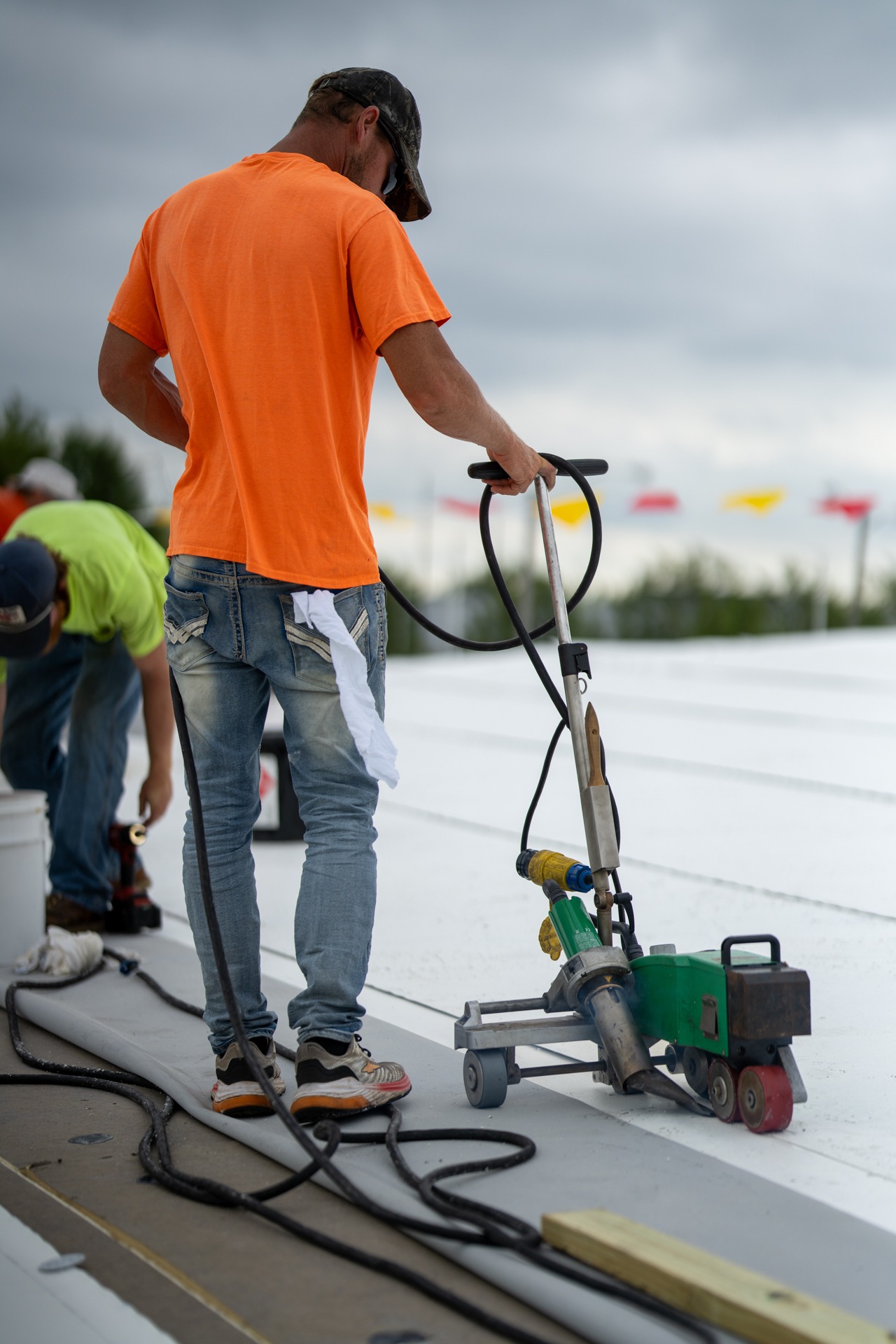
One of the things that matters a lot on a commercial repair — especially if your building is occupied — is how disruptive the work is going to be. On a good day, a crew that knows what they’re doing gets in, does the work, and gets out without making your tenants or staff deal with a lot of noise, dust, or interruption to daily operations.
That’s not always the case with every contractor. Some repairs do require more access or more time, but for a lot of routine flat-roof repair work, it shouldn’t feel like a major construction event inside your building. If a contractor can’t give you a reasonable window of how long the work will take or what to expect in terms of disruption, that’s worth asking about before you schedule anything.
It’s also worth asking who’s doing the work. Is it the company’s own crew, or is it getting subcontracted out? On a repair, that matters — because whoever touches the roof is the one who has to stand behind it.
The Part Nobody Likes to Talk About: Warranties After Repair
Here’s something that comes up more than you’d think. A building owner gets a repair done, assumes they’re covered, and then finds out later that the repair work isn’t backed by any meaningful workmanship warranty — or that the underlying material warranty has terms they didn’t fully understand.
There’s a difference between a material warranty and a workmanship warranty, and a lot of what gets handed out as “warranty” on repair work is material-only — meaning if something fails, you might get replacement materials, but not the labor to install them. And some of those warranties are pro-rated, so the coverage goes down every year.
It’s reasonable to ask any contractor you’re talking to: what does the warranty on this repair actually cover, and for how long? What’s your workmanship guarantee? A contractor who’s been in central Illinois for a long time and plans to stay here is going to have a different answer to that question than someone who showed up after a storm and is moving on to the next market.
How to Get the Process Started
If you’ve got a roof issue — or you just haven’t had anyone up there in a while and you’re not sure what’s going on — the best thing to do is call into the office and let us know what you’re seeing. We’ll figure out what kind of look makes sense and go from there. You can find more on what we do for commercial flat roofs at [https://holthausroofing.com/commercial-flat-roof/].
We work primarily in central Illinois, south of I-80, and get into Iowa and Missouri some as well, so if you’re in that area and you’ve got a commercial property, we’re worth a call.
FAQ
How do I know if my commercial roof needs repair or a full replacement?
The honest answer is you need someone up there to assess it before that question can be answered. Age of the roof, condition of the membrane, scope of the damage, and what system is up there all factor into it. A repair can carry a roof quite a bit further when it’s done right and caught early — but if the overall system is failing in multiple spots, that changes the math. A good contractor should be able to walk you through what they’re seeing and give you an honest read, not just push you toward the bigger ticket.
Will my commercial roof repair be covered by insurance?
It depends on how the damage happened. Storm-related damage — hail, wind, that kind of thing — often is covered, but the process of working through an insurance claim on a commercial property can get complicated. There are code upgrades that adjusters don’t always catch, and the scope of what’s covered isn’t always clear up front. It’s worth having a contractor who’s done this before involved early in the process, not after you’ve already agreed to a settlement.
How long does a typical commercial roof repair take?
For most smaller repairs — a seam, a flashing issue, a localized area patch — it’s usually a matter of hours, not days, and it shouldn’t require a lot of disruption to whatever’s going on inside your building. Bigger repairs or anything that involves structural issues can take longer, but a contractor should be able to give you a realistic window before the work starts. We work hard to get in, get the work done right, and get out without making it a bigger event than it needs to be.