
Residential Roofing
Will a New Roof Pay You Back When You Sell?
A former insurance adjuster on what your roof actually does to an appraisal, a buyer’s offer, and your homeowners policy — including when he’d tell you not to replace it.

Every homeowner I talk to about selling asks some version of the same question: does a new roof increase home value, and will I get my money back? Here’s the honest answer. A new roof does add to what your home is worth — but it usually does not pay for itself dollar for dollar. What it does do, and this is the part that matters more, is keep a bad roof from taking money off your closing table.
I’m Craig Stafford. I’m the steep slope manager at Holthaus Roofing here in Canton, and I handle residential projects start to finish. I’m also a former insurance adjuster, so I’ve been on that side of the fence as well as this side. That means I’ve seen how roof condition gets scored by the people who put a number on your house — appraisers, inspectors, and the carrier writing your policy. Let’s walk through all three. If you’d rather just talk it through, call the office at 309-647-9209.
Does a New Roof Increase Home Value? The Short Answer
Yes, but only partway. And the number moves around more than most people expect. Remodeling magazine puts out a Cost vs. Value report every year that tracks asphalt shingle roof replacement. That’s their report, not our numbers — I’m reading it the same as you would. The 2024 report put it at roughly 57 percent of the cost recouped at resale nationally. The 2025 report came back at about 68 percent. That’s not roofs turning into a better investment, per se. That’s the number moving around from one year to the next, so don’t anchor on any one figure.
Regionally it swings wider yet. In the 2025 report the spread across regions ran from roughly 54 percent on the low end up to 81 percent on the high end. So where you are matters about as much as what year it is. We sit in what that report calls the East North Central region. That one came in a shade over 69 percent, a little better than the national number. That’s the one that actually applies to a house here in Canton.
Generally, when somebody quotes you one confident number on this, they’re rounding off a target that moves every year.
Either way, as a return on investment at resale, you don’t get all of it back.
But that number only tells half the story, and it’s the less important half. The right way to think about it is this: a good roof protects value, and a bad roof actively costs you value. Those are two different things, and the second one is where I see homeowners get hurt.
A Worn-Out Roof Costs You More Than a New One Gains You
Usually, when a roof is at the end of its life, it doesn’t just quit adding value. It turns into a line item somebody else gets to put a price on. And they’ll price it high. They’re guessing, and guessing high doesn’t cost them anything.
Here’s the pattern I see. A buyer’s inspector notes a roof near the end of its useful life. The buyer’s agent asks for a credit. And the number they ask for generally isn’t what a roof costs. It’s what the buyer is afraid a roof might cost, plus a cushion on top of that. Meanwhile the deal slows down. The buyer starts wondering what else got let go. Now you’re on your back foot for the rest of the negotiation. That’s how a roof turns into a whole-house problem in somebody’s head.
The other side of it is quieter, and a lot of times people miss it. When the roof is sound, nobody talks about the roof. It comes off the table, and you’re negotiating from a stronger spot. That’s the real return, and you won’t find it in anybody’s percentage chart. It’s also most of what our residential roofing team is doing for homeowners who call us before they list rather than after.
How Roof Condition Shows Up in an Appraisal
An appraiser isn’t going to climb up and inspect your shingles the way a contractor doing a real inspection would. But they do look at the roof, and there are a few specific things they’re looking for.
Remaining useful life
This is the big one. Generally an appraiser is noting roughly how much life your roof has left before it needs to be replaced, and on some loan types, FHA for one, that’s a specific requirement. A roof with a couple of years left often gets categorized as deferred maintenance, and deferred maintenance pulls your value down against comparable homes with newer roofs. It’s not personal and it’s not a judgment about your housekeeping — it’s just an expense somebody sees coming, and they’d rather it come out of your side than theirs.
Signs of active water intrusion
Sagging areas, ceiling stains, daylight in the attic, missing shingles. Anything suggesting water is getting in raises the question of what it’s gotten into — decking, framing, insulation and so forth. That’s usually where a roof stops being a maintenance note in an appraisal and starts being a structural question, and those are the expensive ones. If you’ve got a leak like that right now, call the office at 309-647-9209. We’ll come look at it at no charge.
Financing conditions
Sometimes the appraisal comes back with a condition attached: the lender wants the roof repaired or replaced before the loan closes. Now you’re doing the work anyway, but on somebody else’s clock, with no time to get real bids. That’s the worst possible position to buy a roof from, and it’s avoidable if you know where you stand before you list.
How Roof Condition Shows Up at the Negotiating Table
The appraisal protects the lender. The home inspection is what protects the buyer, and it’s where roof condition does the most damage to a sale price, because the inspection report is written for the person who’d like to pay you less than you’re asking.
A few things worth knowing about how that plays out:
- Inspectors write it up careful. The risk on their end is missing something, not making it sound worse than it is. So a roof with some ordinary wear usually gets described in terms that sound worse than what I’d tell you standing on it.
- Buyers are pricing what they don’t know, not what the repair costs. Ask three buyers what a new roof runs and you’ll get three different numbers. Generally the highest one is the one that ends up in the counteroffer.
- Documentation will get you further than arguing. Dated photos and a written scope from a local contractor who stands behind their work. That’ll move a negotiation a lot further than insisting the roof is fine. And if the roof is newer, make sure you’ve got the registered warranty certificate — that does more work than either one.
- A roof nobody has to worry about is worth something. When a buyer doesn’t have to think about the roof for fifteen years, that does move offers up. It takes a big expense off the list of things they’re bracing for. That’s the argument for handling a roof replacement on your schedule instead of theirs.
The Insurance Angle Most Homeowners Miss
This is the part of the home-value conversation almost nobody brings up, and it’s the part I know best from my years on the adjusting side. Your roof doesn’t just affect what your home appraises for. It affects whether the next owner can insure it affordably — and increasingly, whether they can insure it at all.
Central Illinois carriers have gotten a lot more particular about roof age since we started getting the hail and wind seasons we’ve been getting. Generally, what I see is this: older roofs get scrutinized harder, some carriers won’t write a new policy over a certain roof age, and some will write it but only settle claims on an actual cash value basis instead of replacement cost. That last one is the one that stings. It means depreciation comes out of the check, and the homeowner covers the difference.
Why that matters when you’re selling: a buyer who calls for a quote and gets told the policy is going to be expensive, restricted, or conditional on replacing the roof has just been handed a reason to renegotiate that has nothing to do with your appraisal. I’ve watched it happen.
It’s worth understanding the types of storm damage that show up on Illinois roofs so you know what your own carrier is going to be looking at, and our storm damage and insurance claims page walks through how we handle the claim side.
I’ll be straight with you about my limits here. I can explain the claims process, tell you what an adjuster is going to look for, and be there when the adjuster comes out. I’m not a public adjuster and I won’t negotiate a settlement for you — I don’t want to overstep that boundary. What I can do is make sure the damage is documented right and explained in plain terms so you’re not going through it blind.
Should You Replace the Roof Before You Sell?
This is the actual decision most people are trying to make, so let me answer it directly instead of hedging. And yes, I’m aware I sell roofs for a living, so take my advice with whatever grain of salt you think it deserves. I’ll still tell you when not to buy one. I do it more often than you’d think.
When replacing before you list is the right call
- The roof is genuinely at or past the end of its life — widespread granular loss, curling and cupping shingles, multiple repairs already.
- There’s active or recent water intrusion. Nothing kills a sale like a ceiling stain, and the longer it sits the more secondary damage builds up behind it.
- You’re in a market where comparable homes are selling with newer roofs, and yours is the one that stands out.
- You’d rather control the work, the timeline, and the price than have a lender or a buyer control it for you.
When I’d tell you not to replace it
And I do tell people this, even though it means I don’t sell a roof that day:
- The roof has real life left. If you’ve got eight or ten good years up there, replacing it before you sell is spending five figures to recoup a fraction. Get it inspected, get the findings and the photos documented, and give your agent that instead.
- A targeted repair solves the actual problem. Sometimes it’s flashing around a chimney, or a valley that needs attention, and not the whole roof. Make sure whoever you call will actually quote you the repair when a repair is what you need.
- You’re selling as-is and you’ve priced it that way. If the price already reflects the roof and the buyer knows going in, putting a new one on is just a gift to whoever buys it.
- You’re up against a closing date. A roof rushed to beat one is how you end up with a crew that nails high and is two counties away by the time the first real wind event tests their work.
If you are not sure which of those four you are in, that is the whole point of getting somebody up there before you list. Generally a roof inspection settles it one way or the other.
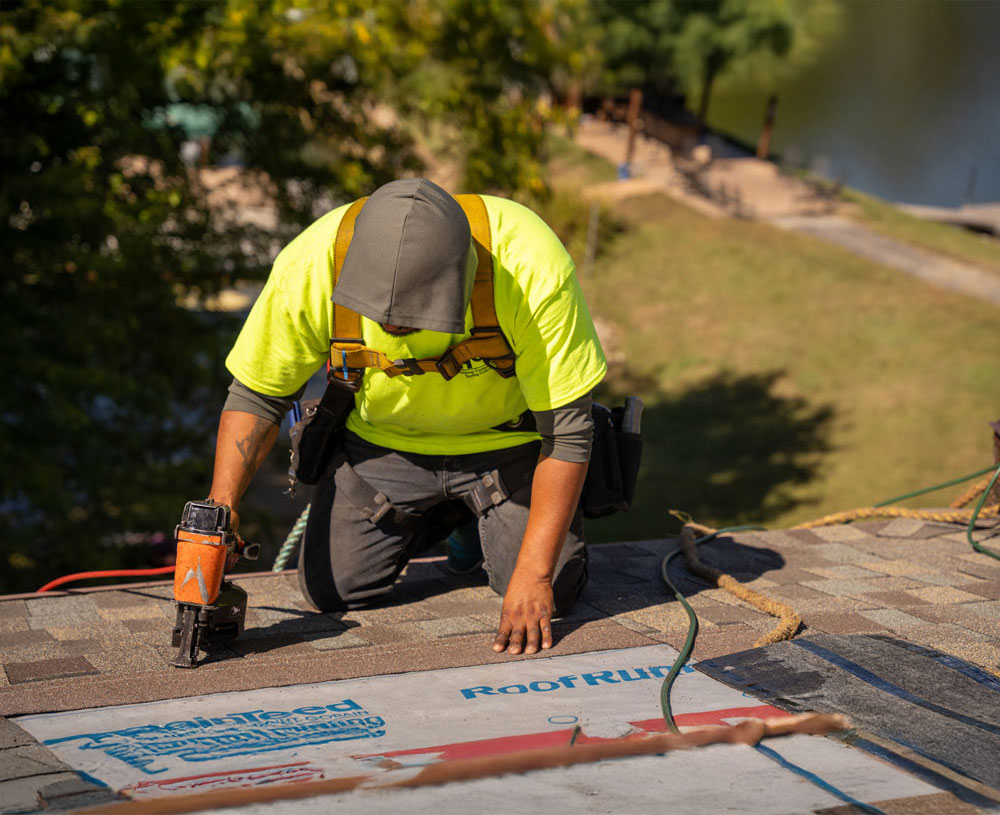
If replacement is the right answer, here’s the standard I’d hold any contractor to, ours included. A typical home is a one-day job. I introduce the homeowner to the lead man who’s going to be on site all day. We tarp the shrubbery and keep one way into the house open so you can come and go, and the debris leaves with the dump trailer at the end of the day. Robyn Scott, one of our homeowners, put it this way in her Google review: “The crew was so respectful of my property and really excelled at cleaning up. Except my beautiful new roof you’d never know they were here.” Ask whoever you’re considering whether that’s what you’ll get, and ask it before you sign. That’s the bar our roof replacement and installation work is built around.
Does the Warranty Transfer? What a Buyer Actually Gets
This is the part sellers routinely leave on the table, so it’s worth a minute. Every roof carries two promises. Number one, the manufacturer covers the shingles. Secondly, somebody has to cover the installation, and generally that’s the contractor. A promise from the contractor is only good for as long as that contractor is around, so the better setup is one where the manufacturer stands behind the installation too.
We’re a CertainTeed ShingleMaster PREMIER contractor, and when we install the full CertainTeed Integrity Roof System — that’s their shingles along with the underlayment, starter, hip and ridge, and ventilation, all working as one system — we register it with CertainTeed for their SureStart PLUS coverage. Here’s what that actually means for you on a qualifying single-family detached home:
- 50 years on materials, non-prorated, on a single-family detached home. Non-prorated is the word to pay attention to. A lot of warranties pay out a shrinking percentage of what you originally spent as the roof gets older. This one covers the full cost of replacing defective shingles and it doesn’t shrink on you.
- Labor, tear-off and disposal are in there too. A materials-only warranty hands you a pile of shingles and leaves you to pay somebody to put them on. This one covers the work.
- On qualifying roofs, workmanship coverage that CertainTeed backs — not just us. That’s the one I’d underline. If the roof was installed wrong, the manufacturer stands behind making it right. You’re not relying on a handshake. The term is printed on your certificate.
- Transferable for 20 years. It can go to the next owner, once. The transfer section of the warranty spells out what the new owner has to do, so ask us for the procedure before you close.
Now the footnotes, because there are a few and you should hear them from me rather than find them later:
- It’s the system that qualifies, not the shingle. CertainTeed shingles by themselves don’t get you there. It takes the full Integrity System — their underlayment, starter, hip and ridge, and ventilation right along with the shingles.
- Not every job is that system. On a basic roof, a rental, or a job spec’d to a tighter budget, what you’ve got instead is the standard manufacturer coverage on the materials plus our own 10-year workmanship warranty on the installation — if we installed something wrong, we take care of it, and it doesn’t require inspections or maintenance to stay in force. Your proposal spells out which one you’re getting, because they are not the same thing.
- Those durations are for single-family detached homes. Other structures are capped shorter.
- Not every shingle gets you 50 years. CertainTeed’s XT25 line, for one, carries a shorter term. Make sure you know which shingle is on your proposal and what its term is.
- It has to be registered after the install, and there’s a clock on it. Ask for your warranty certificate, confirm it got filed, and put it in the file with your closing documents.
- Ask to see the current SureStart PLUS document. CertainTeed has changed these terms before, and the version that governs your roof is the one in force the day it gets registered, not the one on a web page.
The registration footnote is the one that matters in a sale. A buyer can hold a registered warranty certificate in their hand. They just have to take your word for the roof being eight years old.
So whoever you end up hiring, ours or somebody else’s: ask what warranty comes with the roof, ask who backs the labor, ask whether it transfers and what you’d have to do to transfer it — and get those answers on paper before you sign anything. Anybody who stands behind their work will hand that over without blinking.
What Actually Drives the Cost of a New Roof
I’m not going to print a price range on a web page, and I want to tell you why instead of just leaving a hole where the number should be. Any figure I put here would be a guess about a roof I haven’t seen, and a guess is exactly what gets used against you later — by a buyer, by an adjuster, or by the next contractor who quotes off it.
What I can do is tell you exactly what moves the number, so when you get real quotes you can tell whether they’re even quoting the same roof.
- Size and pitch. Square footage is the obvious one. Pitch matters just as much — a steep roof is slower and takes more safety setup, and that’s labor.
- How many layers come off. One layer of shingles to tear off and haul away is a different job than two or three. On older homes around here that’s a real variable.
- What’s under the shingles. Decking condition is the one nobody can price from the driveway. If we open it up and find rotten sheeting, that gets brought up to you right up front with photos before we do anything — we’re not going to cover up something somebody else didn’t do correctly the first time.
- Shingle line. A Landmark is not priced like a Landmark Pro, and neither is priced like Presidential. Same roof, different material cost.
- Complexity. Valleys, dormers, chimneys, skylights, wall transitions and so forth all mean more flashing and more cut-in work than a simple gable.
- Access and cleanup. Where the dump trailer can sit, what has to be tarped, how far material has to be carried.
Usually if two quotes are far apart, one of those six items explains it — and usually it’s the decking or the layers. Ask both contractors which one they assumed.
Protecting Roof Value Without Replacing Anything
Most of the value in a roof is protected years before anybody talks about selling, and it’s cheap compared to the alternative.
- Keep the valleys clear. Leaves dam up in the low spots and hold moisture against the shingles. Those areas wear out first, and it’s entirely preventable.
- Trim branches back from the roofline. A limb that comes down does real damage, and squirrels and raccoons use overhanging branches as a bridge onto your roof.
- Look from the ground after a storm. Missing or lifted shingles, and granular in the gutters. Granular is the crushed rock, almost like coarse sand, that protects the asphalt from the sun. A little coming off is normal on a newer roof; a lot of it at once after a storm is not.
- Get eyes on it once or twice a year. You won’t see a flashing or nailing problem from the driveway. Usually you find out about it when it shows up on a ceiling.
Ventilation and attic insulation matter here too — they quietly determine how long the roof above them lasts. We go deeper on both in roof ventilation and roof longevity and how a roof replacement affects energy efficiency.
What This Looks Like in Canton and Fulton County
A couple of things are specific to where we work. We’re a Canton roofing contractor, and we cover Fulton County and the surrounding communities — Lewistown, Farmington, Havana, and on out to Peoria and Macomb, with a second office, by appointment, in Pekin.
A lot of the housing stock out this way is older, which means a fair number of roofs are carrying their second or third layer of history. What’s under the shingles ends up mattering as much as the shingles when an appraiser starts asking about condition, and it’s the single biggest reason two quotes on the same house can come back a long way apart.
And we take weather here. Spring hail, straight-line summer wind, ice at the eaves in January. Illinois weather wears a roof down year after year in ways that don’t announce themselves, and it’s the reason a roof in Central Illinois can look fine from the street and still be closer to the end than the owner thinks.
Holthaus Companies, Inc. has been doing this out of Canton for 35 years, since 1991, and we’re not going anywhere. That matters for warranty work, and it matters when the storm crews come through town after a hailstorm and start knocking on doors. If you’re weighing who to have look at your roof, our post on what to look for in a licensed roofing contractor lays out the same list I’d give you if you called and asked. Our Illinois roofing license number is 104.007039, and you can check it with the state. Either way, our residential roofing team handles it start to finish — inspection, documentation, and the repair or replacement itself.
The Plan, In Order
If you’re selling in the next year or two, this is the order I’d do it in:
- Get the roof inspected before you list — not after a buyer’s inspector writes it up for you. Call the office at 309-647-9209 to get on the schedule.
- Get the findings documented — photos of what’s actually up there, and a straight answer on roughly how much life is left.
- Give your agent that documentation so the roof is a known quantity instead of an open question somebody else gets to price.
- Fix what actually needs fixing — usually flashing, a valley, or a small section, not the whole roof.
- Replace only if it meets the criteria above, and do it on your timeline rather than a closing deadline.
So a new roof does increase home value some, and less than most people hope. Knowing the real condition of your roof before somebody else gets to price it for you protects your home value every time, and it costs a lot less. That’s where I’d put your energy.
Find Out What You Actually Have Before You List
Schedule a roof inspection before a buyer’s inspector does it for you. We get up there, photograph what we find, and walk you through it — including, if that’s the answer, that you don’t need a new roof. Straight either way. Call the office at 309-647-9209. The office gets residential calls to me, and we’ll set a time to get up there.
Holthaus Companies, Inc. · 875 E Linn St, Canton, IL 61520
Frequently Asked Questions
Does a new roof increase home value?
Yes, but generally not dollar for dollar, and the figure moves year to year. Remodeling magazine’s Cost vs. Value report put asphalt shingle roof replacement at roughly 57 percent of cost recouped at resale in its 2024 report and about 68 percent in its 2025 report. Regionally the 2025 spread ran from roughly 54 percent to 81 percent, so where you are matters about as much as what year it is. The bigger effect is defensive: a worn-out roof becomes a credit a buyer asks for and a condition a lender attaches, while a sound roof takes the whole subject off the negotiating table. Protecting value is where the real money is.
Should I replace my roof before selling my house?
Only if it genuinely needs it — end of life, active leaking, or a history of repairs. Replacing before you list keeps you in control of the timeline and the price rather than a lender or a buyer’s agent. If there’s real life left, don’t: an inspection and documented findings do most of the same work for a fraction of the cost.
Will a bad roof cause an appraisal or a sale to fall through?
It can, and the lender is the part people don’t see coming. An appraiser can categorize a roof near the end of its life as deferred maintenance, which pulls value down against comparable homes. Separately, the lender can attach a condition requiring the roof be repaired or replaced before the loan closes — which means you’re buying a roof on somebody else’s deadline with no time to shop it.
How does roof age affect homeowners insurance?
Generally, older roofs get scrutinized harder. Some carriers won’t write a new policy past a certain roof age, and some will write it but settle claims on an actual cash value basis rather than replacement cost, which means depreciation comes out of the check and the homeowner covers the difference. Since Central Illinois has been getting the hail and wind seasons it’s been getting, carriers here have gotten more particular about it. When you’re selling, a buyer who gets a restricted or expensive quote has a reason to renegotiate that has nothing to do with your appraisal.
Does a roof warranty transfer to the new owner when you sell?
It depends on the warranty, which is why you ask before you hire rather than after. On a single-family home where we install the full CertainTeed Integrity Roof System and register it after the install, CertainTeed’s SureStart PLUS coverage runs 50 years non-prorated on materials and labor, and on qualifying roofs it includes workmanship coverage backed by CertainTeed rather than by us. It can transfer once, to a buyer, for up to 20 years. The transfer section of the warranty spells out what the new owner has to do, so ask for the procedure before you close rather than assuming. A job that isn’t that full system carries the standard manufacturer warranty on the materials plus our own 10-year workmanship warranty on the installation, so ask which one you’re getting. A contractor-backed workmanship warranty, by contrast, is generally only as good as that contractor still being in business. Ask who backs the labor, ask whether it transfers, and ask for the registered certificate for your file.
How can I protect my roof’s value without replacing it?
Clear valleys, branches trimmed back off the roofline, a look from the ground after storms, and an inspection once or twice a year. None of that raises your appraisal. It keeps you from losing value you already have, which is the cheaper half of this conversation by a wide margin.