Storm Damage & Insurance
The Post-Storm Walk-Around, in the Order I’d Do It
A former insurance adjuster walks central Illinois homeowners through how to spot roof damage after a storm from the ground — what to look at, in what order, and when it’s worth a phone call.

The storm rolls through overnight, and in the morning you’re standing in the driveway with a cup of coffee looking up at a roof that looks about the same as it did yesterday. There are branches down in the yard. The neighbor’s trash can is in your flower bed. But the roof? It looks fine.
That’s the part that trips up most homeowners. Storm damage on a roof is usually not dramatic. It’s a lifted shingle that settled back down. It’s a bruise in the shingle mat you’d never pick out from the driveway. And the whole time it’s sitting up there unnoticed, two clocks are running: water is finding its way in, and your insurance policy’s reporting window is getting shorter.
I’m Craig Stafford, the steep slope manager here at Holthaus Roofing in Canton. Before this, I was an insurance adjuster, so I’ve been on that side of the fence as well as this one. Homeowners around Canton and Fulton County ask me how to spot roof damage after a storm more than any other question, and what follows is the order I’d walk it in if it were my own house — ground first, attic second, roof last, and only by somebody who does it for a living.
What Central Illinois Actually Throws at a Roof
Around here the calendar does a lot of the work for you. Generally, spring through early summer is our hail window — that’s when I get most of my calls, and it’s when the damage is hardest to see. Summer brings straight-line wind, and out on this flat farm ground west of the river there isn’t much to slow it down before it hits the west and south slopes of your house. Winter is a different animal altogether: ice dams at the eaves, where melt runs down, refreezes over the cold overhang, and backs water up under the shingles. It plays out the same way whether you’re in Canton, out toward Macomb, or over in Peoria and Pekin — the same fronts cross all of it.
That matters for how you look. Wind damage clusters on the windward slopes and along ridges and rake edges. Hail scatters everywhere but shows itself first in the gutters. Ice shows up as a stain on the ceiling of the room below the eave, usually in February, from a storm you already forgot about. And in the older in-town neighborhoods around Canton and Farmington, where mature trees sit right up against the house, add limb strikes — those are the ones that actually puncture a deck.
First Rule: Stay Off the Roof
Let me get this one out of the way, because it’s the most important thing on the page and everything else is just a checklist.
Do not climb up there. Not on a ladder to “just take a quick look,” not the day after a storm when the shingles are still damp and there’s granular washed down into the valleys making it slick as ice. I do this for a living and I still won’t tell a homeowner to get on their own roof. The two worst outcomes of a post-storm inspection are a fall, and a homeowner walking across soft decking they had no way of knowing was soft.
You can learn most of what you need to know with two feet on the grass. Here’s how.
The Signs of Storm Damage You Can See From the Ground
Give yourself twenty minutes and walk a full lap around the house. Take your phone. Photograph everything you find, and don’t delete anything — date-stamped photos taken right after the event are the single most useful thing a homeowner can hand me later.
1. Start at the downspouts and in the gutters

This is where I’d start every time. The granular is the crushed-up rock on the surface of an asphalt shingle — it looks like coarse sand, and it’s doing several jobs at once: shielding the asphalt underneath from sunlight, adding fire resistance, and giving the shingle its color. When hail hits a shingle hard enough, it knocks that granular loose, and gravity does the rest.
Look in the gutter troughs and at the splash block or the ground under each downspout outlet. A little bit of granular is normal, especially on a newer roof — even our crews walking around during an install will loosen some up and it rolls down into the gutter. What you’re looking for is a pile. If there’s a coarse black-and-gray drift in the bottom of the gutter or a fan of it spread out under the downspout that wasn’t there last week, something up there took a beating.
2. Check the soft metal before you check the shingles
This is the trick I brought with me from adjusting, and it’s the one most homeowners have never heard. Hail doesn’t aim. If it was big enough and hard enough to bruise your shingles, it also hit everything else in the yard — and soft metal shows a dent far more honestly than a shingle does.
So walk over and look at the gutters and downspouts from the side, in raking light. Look at the aluminum fins on the outdoor A/C unit. Look at roof vents, the metal on the garage door, the mailbox, a grill lid, anything painted and soft. Dents in soft metal don’t automatically mean your roof needs replacing — but they tell you the storm had the energy to do it, and that changes the question from “was there hail here?” to “how much did the roof take?”
3. Read the roof line against the sky
Back up to the far corner of the yard and look at the roof in profile against the sky, not straight on. Binoculars help. From that angle you’ll pick up things you cannot see standing under the eave: shingle tabs standing slightly proud of the course below them, a wavy or scalloped line along a ridge or a rake edge, a dark rectangle where a tab is gone entirely, flashing that’s pulled away from a chimney or a sidewall.
Wind is sneaky in a way hail isn’t. A gust can break the seal strip that glues one shingle down to the next without moving the shingle anywhere. It looks completely normal from the driveway, and it will act like a sail in the next storm. That’s why “I’m not missing any shingles” isn’t the all-clear people think it is.
4. Walk the yard and the valleys
Look at what came down. Branches and limbs on the ground mean branches and limbs came off something, and if a big one came off a tree that overhangs the house, assume it hit the roof on the way. While you’re looking up, check where two roof planes meet — if leaves and small debris have packed into a valley, you’ve got a dam, and the next hard rain backs up under the shingles instead of running off. Trimming those branches back is the cheapest roof maintenance there is, and it takes the squirrels and raccoons out of the equation at the same time.
Also pick up any shingle pieces or torn tabs you find in the yard or in the flower beds. Homeowners throw those away all the time. Don’t — set them aside. That’s evidence.
Then Go Inside and Look at the Attic

The attic is the honest room in the house. Take a good flashlight, turn the attic light off, and give your eyes a minute to adjust. Make sure you’re stepping on the framing members and not on the drywall between them — a foot through the bedroom ceiling is a worse afternoon than the storm was.
You’re looking for four things:
- Pinpricks of daylight coming through the roof deck or around penetrations. Ignore the continuous slot of light at the peak if you have a ridge vent — that one is supposed to be there.
- Dark staining or streaking on the underside of the sheathing and running down the rafters.
- Insulation that’s matted or damp to the touch, or that’s been displaced by wind driving through a gap.
- Soft or spongy decking — run your hand along the sheathing where it meets the eave. That one is not a wait-and-see item.
One thing I’d set aside: widespread rust on the nail points and frost on the sheathing in winter usually isn’t storm damage at all. That’s a ventilation problem — condensation from the house getting into a poorly vented attic — and it’s worth fixing, but it’s a different conversation and a different repair.
One timing note that catches people: a leak needs rain to show itself. If the storm was mostly wind or hail and the rain came later or not at all, the attic can be perfectly dry today and stained a week from now. Make a habit of going back up after the next real rain.
What the Ground Check Can’t Tell You

I want to be straight about the limits of everything above, because plenty of contractors will let you believe a driveway inspection settles it.
Hail bruising is the big one. A hail hit that matters shows up as a soft spot — the mat under the surface is fractured and it feels different under a thumb than the shingle beside it. You have to be on the roof, on your knees, to find that; from the ground it is effectively invisible. Same goes for compromised nailing zones, a seal strip that’s let go across a whole slope, and cracked boots around plumbing vents.
So the honest framing is this: your walk-around tells you whether it’s worth having somebody get up there. It doesn’t tell you the roof is fine. If you want the detail on what each kind of damage actually does to a roof, we broke that out separately in our guide to the types of storm damage that hit Illinois roofs, and there’s more on repairs and the claim itself on our storm damage roofing page.
Timing: Why I Push People Not to Sit On It
Here’s where the adjuster half of my background is actually useful.
Homeowners policies generally require you to report damage promptly, and while the exact language varies from carrier to carrier, the practical problem is the same everywhere: the longer you wait, the harder it gets to prove the damage came from that storm and not from the two years of weather that followed it. I’ve sat on the carrier’s side of that conversation. A claim filed three weeks after a documented hail event with dated photos is a straightforward file. The same damage reported the following spring is an argument.
So the move isn’t to panic, and it isn’t to file on every gust of wind. It’s to find out what you actually have, in writing, while the storm is still fresh.
When It’s Worth a Call — and When It Isn’t
I’d rather tell you the truth than book an appointment, so here’s both halves of it.
Worth having somebody look:
- Hail bigger than a quarter came through.
- You found granular piling up in the gutters or under the downspouts.
- You can see dents in the gutters, downspouts, roof vents, or A/C fins.
- A limb came off onto the roof.
- There’s any new stain, damp spot, or daylight in the attic.
- Your roof is already fifteen-plus years old — an older roof takes the same storm harder.
- A neighbor down the block is having their roof replaced from the same storm.
Probably not worth a claim on its own:
- A couple of small branches in the yard and nothing else.
- A gutter that pulled loose at one hanger.
- The ordinary granular shedding you’ll see for the first year on a brand-new roof.
- One or two shingles you can point at, on a roof that’s otherwise in good shape.
The money part, since nobody likes to say it out loud
You pay your deductible; your carrier pays what’s above it. The thing that catches people out is that many Illinois homeowners policies now carry a separate wind-and-hail deductible written as a percentage of your dwelling coverage rather than a flat dollar figure. Those percentages commonly run 1% to 2%. Do that arithmetic before you call anybody:
- A $250,000 dwelling limit with a 1% wind/hail deductible means you pay the first $2,500 — not the $1,000 flat deductible you’ve got in your head.
- Same house at 2% is $5,000.
- Meanwhile a typical repair — a slope of blown-off shingles, a cracked vent boot, resealed flashing — often lands in the hundreds to low thousands.
Which means on a lot of jobs, filing gains you nothing: you pay for it either way, and now you’ve got a claim on your record. Generally, a claim makes sense when the damage clearly exceeds that deductible by a real margin and it’s clearly storm-related rather than age. That’s the whole calculation. Go read your declarations page. Anybody telling you to file on every storm isn’t doing you a favor.
One more thing, and I say this without knocking anybody in particular. After a big storm the door-knockers show up in this area within days. Some of them do fine work. Some of them are rushing to the next roof, the shingles don’t get nailed on correctly to begin with, and there’s nobody standing behind that labor a year later when it starts leaking. Before you sign anything, make sure the contractor is licensed and insured in Illinois — ours is state license 104.007039 — that the trucks are lettered, that the reviews are real and local, and that they’ll still be here in the long run. Holthaus has been in Canton since 1993, and we’re a CertainTeed ShingleMaster PREMIER contractor. To be precise about what that does and doesn’t buy you: CertainTeed’s material warranty covers the shingles no matter who nails them on. The credential is what lets us extend their SureStart PLUS coverage over the workmanship too — and that only applies if the roof is installed to spec with the matching components and registered afterward. A warranty nobody registered isn’t a warranty. Ask whoever knocks on your door which one they’re offering. We wrote a full checklist for that in what to look for in a licensed roofing contractor.
And to be clear about the neighbor on that first list: another roof going on down the block tells you the storm was strong enough to total one on your street, which is useful. It is not a reason to sign with whoever is parked in their driveway. Those are two different facts.
What Happens When We Come Out
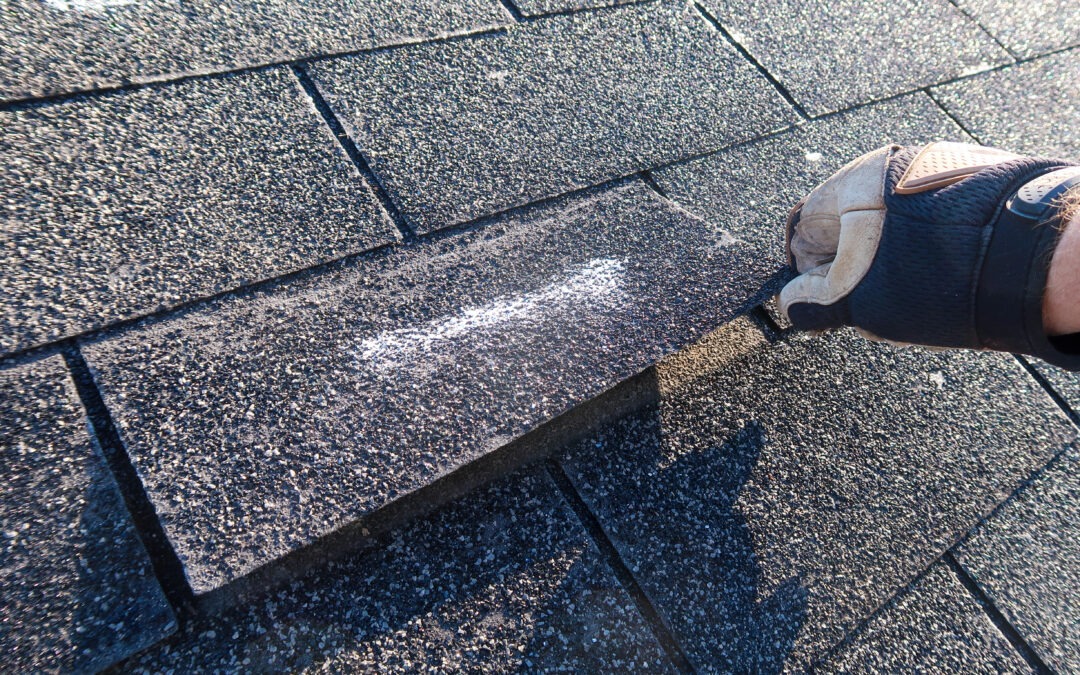
Not much of a production, honestly. Somebody from our crew gets on the roof, walks the slopes, and chalks and photographs anything that qualifies. Then we come back down and I show the homeowner the photos on a tablet right there in the driveway — the good news and the bad news both. If we find rotten decking or bad sheeting under a soft spot, you hear it from us up front, not as a surprise on an invoice.
If it does turn into a job, you’ll meet the lead man who’s going to be on your house all day, we’ll spread tarps over the shrubbery and keep one way into the house clear for you, and the dump trailer leaves with the crew at the end of it. But that’s getting ahead of things.
From there you get a straight answer in one of three directions: there’s no real damage and you should do nothing, there’s damage but it’s a repair, or there’s damage that’s worth putting in front of your insurance company. If it’s that third one, I can walk you through what the adjuster is going to be looking for and be there when they come out. I’m not a public adjuster and I won’t negotiate your claim for you — that’s a line I don’t cross — but understanding the process from both sides tends to make it go a lot smoother. I wrote more about that in how a roofing contractor with adjuster experience helps with an insurance claim.
It’s a free inspection, there’s no obligation attached to it, and if the answer is that your roof is fine, that’s a perfectly good answer and I’ll tell you so. You can see the rest of what we handle on the residential roofing side, or just call the office at 309-647-9209 and ask for me.
Had a Storm? Let’s Find Out What You’re Actually Looking At.
We’ll get on the roof, photograph what’s there, and give you a straight answer — repair, replace, or nothing at all. Free inspection, no obligation, anywhere around Canton, Fulton County, and the Peoria area.
Frequently Asked Questions
How do I know if my roof has storm damage?
Work the four ground-level signals in the checklist above — granular in the gutters, dents in soft metal, a wavy roof line in profile, and stains or daylight in the attic. Any one of them means it’s worth having someone get up there. Generally, though, the damage that matters most — hail bruising and failed seal strips — can’t be seen from the ground at all, so a clean walk-around isn’t proof the roof is fine.
What does roof storm damage look like from the ground?
Usually less dramatic than people expect. Wind damage tends to look like a wavy or scalloped line along a ridge or rake edge, shingle tabs standing slightly proud of the course below, or a dark rectangle where a tab tore off. Hail damage rarely shows itself directly — what you see instead is the secondary evidence: coarse black granular piling up in the gutter troughs and fanning out under the downspout outlets. Look at the roof in profile from the far corner of the yard rather than standing under the eave, and use binoculars if you have them.
Should I get on my roof to check for damage myself?
No. I do this for a living and I still won’t tell a homeowner to climb up there. If you want a closer look without leaving the ground, zoom in with your phone camera from the far corner of the yard, or shoot from an upstairs window across the ridge — that will resolve a lifted tab or a missing shingle just fine. What it won’t resolve is hail bruising, which has to be felt by hand. Worth knowing too: a fall off your own ladder is a health-insurance problem, not a homeowners-claim problem, and it won’t strengthen your roof claim one bit.
How soon after a storm should I have my roof inspected?
Sooner is better, and that’s the adjuster in me talking. Homeowners policies generally expect damage to be reported promptly, and the practical issue is proof: the longer the gap between the storm and the inspection, the harder it becomes to show the damage came from that event rather than the weather that followed. A claim filed a few weeks after a documented hail event with dated photos is a clean file. The same damage reported months later turns into an argument. Take photos the morning after and get an inspection while it’s fresh.
Does granular loss always mean I need a new roof?
Not at all — and this is where a lot of homeowners get talked into more roof than they need. Granular in the gutter tells you to look; it doesn’t decide anything by itself. What actually settles it is the same method an adjuster uses on the roof: mark off test squares on each slope and count the genuine hail impacts inside them. Enough hits per square across enough slopes and the roof is a replacement; a handful of hits and it’s a repair or nothing at all. Different carriers set that bar differently, which is exactly why I’d rather document it properly than guess from the driveway.